
For the Chamber and its members, 2025 proved to be an extraordinary year. From tariffs to export controls, businesses faced an unprecedented level of global uncertainty. ‘Involution’ became a household term amidst persistent weak demand in the face of strong supply growth, and while some companies managed to grow top lines, many more of our members experienced shrinking margins.

In this environment, China’s exports continued to skyrocket, with the European Union (EU) one of their main destinations. While still bringing immense value to both sides, the EU-China trade relationship has been under strain throughout the year, in part due to the renminbi sinking to a 10-year low against the euro,[1] which, coupled with the ongoing factory gate deflation in China,[2] has brought down the price of Chinese goods in Europe, further limiting the ability of certain core EU industries to compete. With Brussels now deciding that corrective action is necessary but not yet having set a clear direction, the year will end with more questions than answers as to how the EU-China trade relationship will evolve.
The United States (US)-China trade war has also been a defining feature of 2025, with tariffs at unprecedented levels imposed throughout the first half of the year and export controls causing significant collateral damage, including for European companies. While the late October US-China trade deal put a stop to further deterioration, companies remain on edge given how quickly new escalations can occur.
This tumultuous year marked an important milestone as well: the Chamber celebrated its 25th anniversary, looking back on a quarter century of advocacy aimed at ensuring that our members’ concerns remain top of mind for key decision-makers. 2025’s complex set of challenges meant that while little time was left for anniversary celebrations, each day that passed further confirmed the value proposition that the Chamber provides its members as an advocacy platform.
2025—which marked 50 years of diplomatic relations between the EU and China—was indeed a busy year for advocacy in both Brussels and Beijing. Chamber representatives met with key European stakeholders during two EU tours and held numerous meetings with various Chinese government bodies throughout the year. The EU-China Summit in July, despite low expectations, proved to be a useful platform to discuss business issues at the highest level, with the Chamber co-organising the China-Europe CEO roundtable, an exchange that had not taken place in that form since 2018.
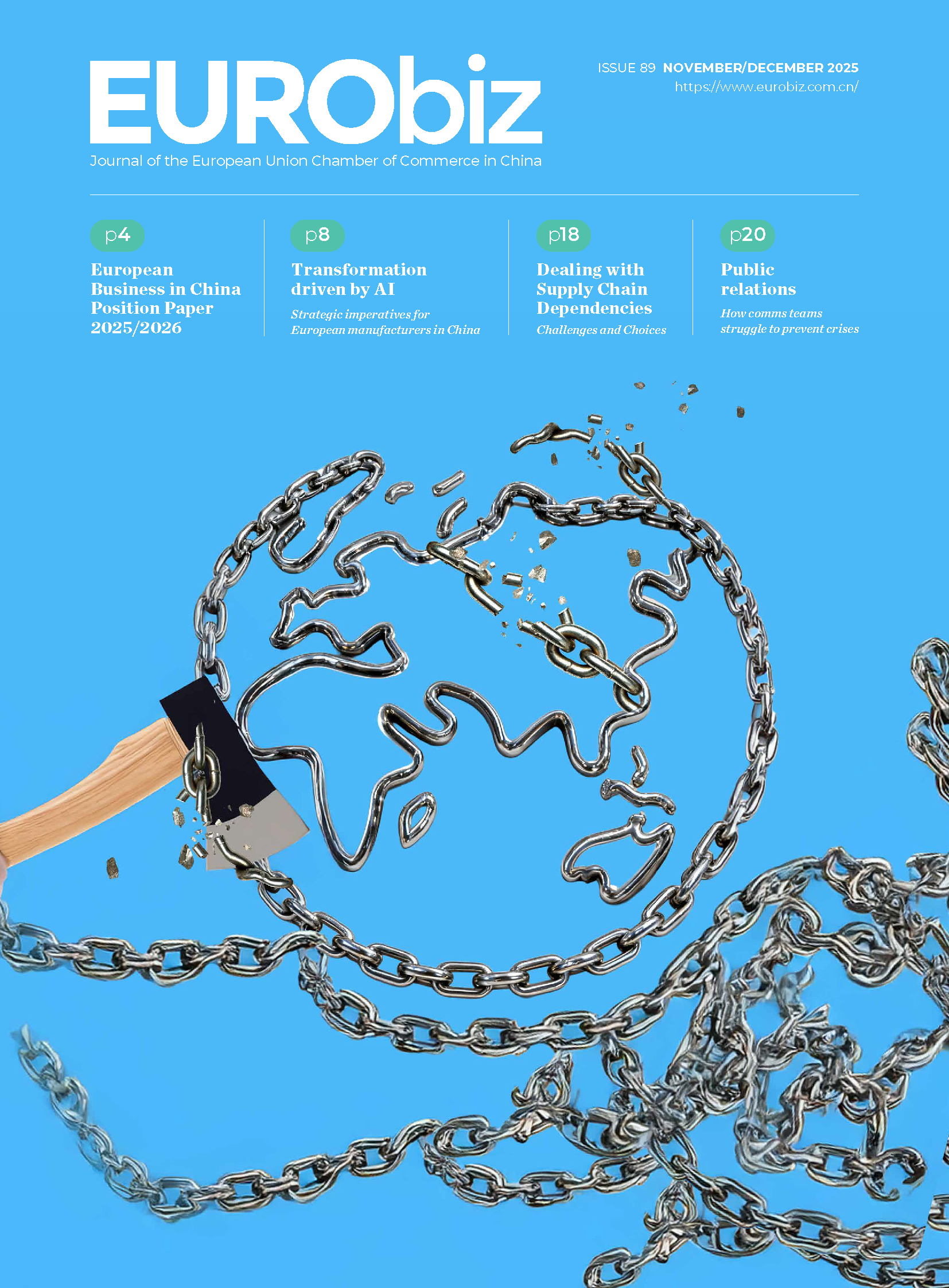
The Chamber also released five high-quality reports in 2025, starting off with Siloing and Diversification: One World, Two Systems, followed by Made in China 2025: The Cost of Technological Leadership, the Business Confidence Survey 2025, the European Business in China Position Paper 2025/2026 and finishing with Dealing with Supply Chain Dependencies: Challenges and Choices. In addition, hundreds of meetings and events held nationally ensured that members remained engaged.
Heading into 2026, we will continue to help our members
navigate an increasingly complex environment. The 15th Five-year
Plan, expected to be released in March 2026, will anchor discussions in the
first half of the year, but beyond that, uncertainty remains the only certainty.
Regardless, as the Chamber enters its 26th year, it will continue to
leverage its voice to advocate for an improved business environment, keeping
members’ concerns in the spotlight.
[1] Cho, Y., and Kawai, Y., Yuan hits 10-year low against euro, threatening trade tensions, Nikkei Asia, 2nd May 2025, viewed 10th November 2025, <https://asia.nikkei.com/business/markets/currencies/yuan-hits-10-year-low-against-euro-threatening-trade-tensions>
[2] Wong, K., and Wu, X., China’s consumer prices return to growth as deflationary pressures persist, South China Morning Post, 9th November 2025, viewed 10th November 2025, <https://www.scmp.com/economy/china-economy/article/3332087/chinas-consumer-prices-return-growth-deflationary-pressures-persist>

Recent Comments